They Carved It Into the Seal and Stamped It on the Coin
You do not have to take anyone’s word for this one. The renaming is not only in the archives — it is on the official seal of a state and on the money that passed through your grandparents’ hands. These are government emblems. You can pull every one of them up in ten seconds and see it for yourself.
On the Great Seal of Massachusetts, a colonial arm holds a raised sword over the head of a Native figure.
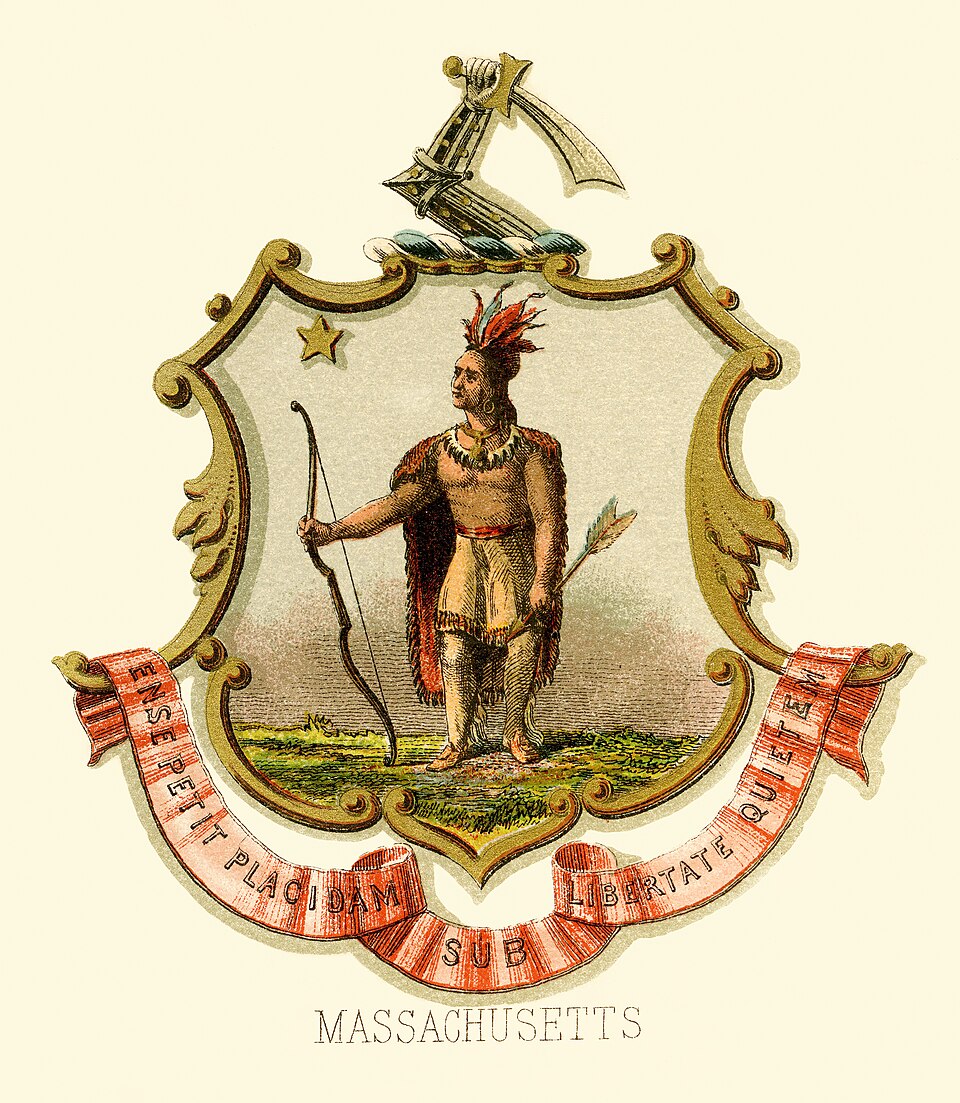
The shield shows a Native man holding a bow and an arrow pointed downward — in heraldry, the sign of peace. Above him, the crest is a bent, armored arm gripping a raised broadsword. The blade hangs over the figure. The sword was modeled on the weapon of Myles Standish, the Plymouth military leader who beheaded the Native leader Wituwamat in 1623. The motto beneath reads:
“Ense petit placidam sub libertate quietem” — By the sword we seek peace, but peace only under liberty.— Motto of the Great Seal of the Commonwealth of Massachusetts (arms adopted 1775; reaffirmed by John Hancock, 1780)
This is not a fringe reading. Massachusetts itself convened an official commission to redesign the seal because the image has “long been viewed… as racist, symbolizing white supremacy and ethnic cleansing perpetrated against the indigenous peoples of this region.” The state admits what its own seal shows: a blade held over the people who were already here.
The “Indian Head” penny is not a Native face. It is Liberty — wearing the Native headdress.
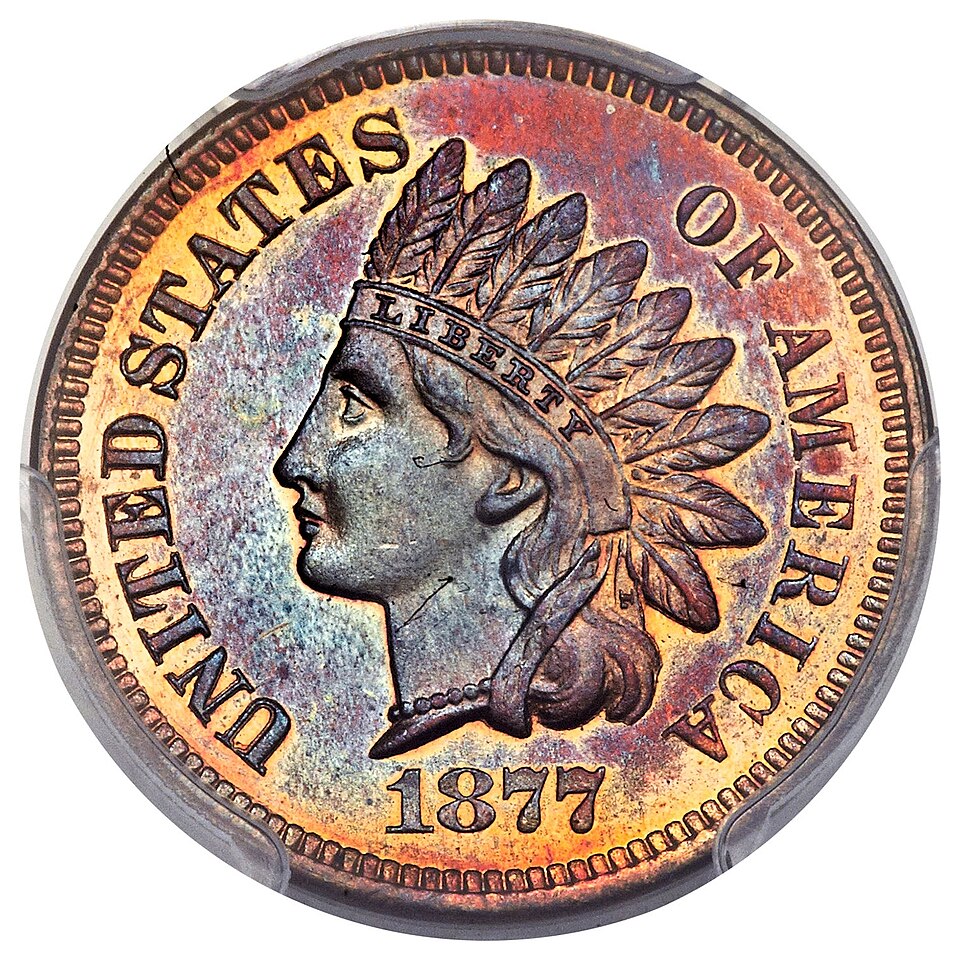
The Indian Head cent (U.S. Mint, 1859–1909) was designed by James Barton Longacre. The U.S. Mint’s own record describes the figure not as a Native American, but as a personification of Liberty wearing an eagle-feathered headdress. Numismatic history is blunt about the pattern: the “Indians” on U.S. coins were, until 1913, “primarily Caucasian with an Indian headdress.”
Read what that is. The personification of America itself wears the found-here people’s headdress — on the nation’s own money — at the very time the actual people were being renamed and removed. The word American was taken from them (Webster’s 1828 dictionary defined it as the “copper-colored” people found here); the image was taken too, and stamped on the coin. The name-chain, struck in copper.
On the seal of Minnesota, the settler plows forward while the Native rides off into the setting sun.
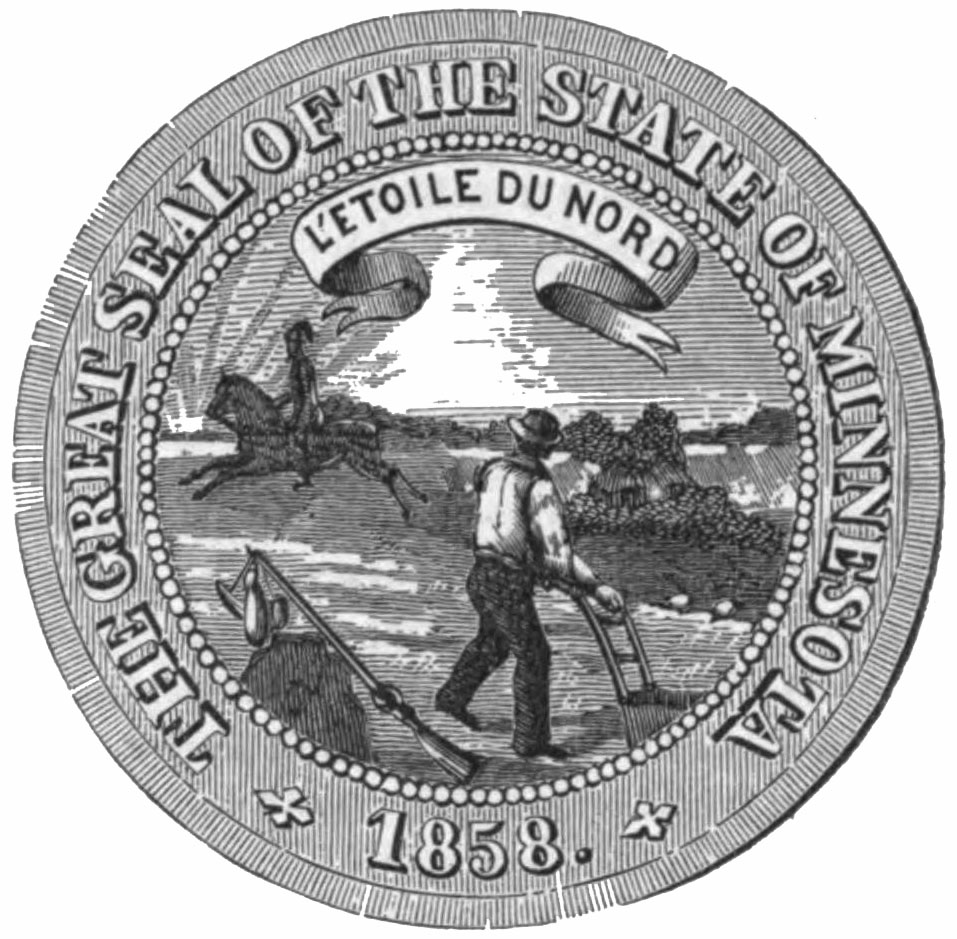
A farmer works the ground in the foreground; a Native man on horseback rides away toward the horizon. Governor Henry Sibley flipped the scene so the rider heads into the setting sun — the “vanishing Indian” written directly into the composition: the plow advances, the found-here man recedes and disappears. The Minnesota Department of Human Rights concluded the seal placed Native Americans in “a derogatory light,” and it was replaced in 2024.
These are not artists’ opinions. They are official government emblems — the state confessing the operation in its own insignia.
Empires say the quiet part in their symbols. Russia stamped the conquered black dragon of Tartary under the horse on its imperial arms; the United States raised a colonial sword over the Native on a state seal and dressed Liberty in the Native’s headdress on its coin. The subjugation and the taking of the name were not hidden — they were engraved, minted, and flown. Look at your own state’s seal. The record is in the picture.